- Home
-
Products
-
Product collection
-
- Application
- OEM&ODM
- News
- About Us
- Contact Us

For all-in-one PC manufacturers, storage performance has become a key indicator of product competitiveness—continuing to use SATA SSDs in the future will likely lead to market obsolescence. The NVMe protocol has long been the mainstream for high-performance storage, and its speed boost and stability are the core leverage points for all-in-one PCs to break through the market barrier. So, why is NVMe a must-have?
I. Industry Consensus: NVMe Replacing SATA is an Irreversible Trend
In the increasingly competitive all-in-one PC industry, "no lag" and "fast response" have become core demands for end-users, and storage solutions are crucial in determining this experience. Traditional SATA SSDs, limited by interface bandwidth, have long been unable to keep up with the performance upgrade pace of all-in-one PCs: loading delays when running multitasking office software, stuttering when processing high-definition materials, and excessively long boot times not only lower the user experience but also directly affect product reputation.
In contrast, NVMe protocol SSDs, with their PCIe channel direct connection to the controller, completely break the bandwidth constraints of the SATA interface. From the perspective of industry technology iteration, NVMe has become a standard feature in mid-to-high-end all-in-one PCs, and even entry-level models are beginning to adopt it in large quantities—this is not simply following a technological trend, but rather an inevitable response to the market's demand for "high-performance storage." For all-in-one PC manufacturers, early deployment of NVMe solutions is crucial to gaining a differentiated advantage from competitors and avoiding the passive situation of "product obsolescence."
II. Core Advantages: 6x Speed Leap, Addressing All-in-One PC Storage Pain Points at Their Root
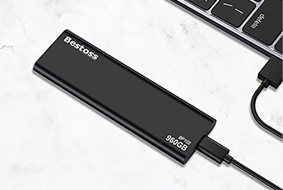
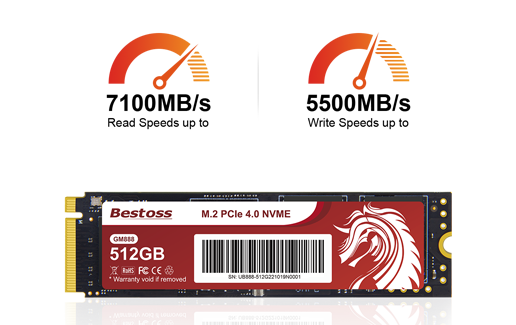
The most direct manifestation of the value of the NVMe protocol for all-in-one PC products is its performance breakthrough: Speed Surpasses SATA: Bestoss NVMe SSDs achieve sequential read/write speeds of up to 3500MB/s, which is 6 times faster than traditional SATA SSDs. All-in-one PCs equipped with this solution can boot up in under 10 seconds. When running Adobe design software and high-definition video playback software, loading response speeds are significantly improved, completely eliminating interface lag and data transmission delays.
Adaptable to diverse scenarios: Whether it's multitasking on a business all-in-one PC, reading and writing materials on a design all-in-one PC, or running large applications on a home entertainment all-in-one PC, NVMe's high-speed performance can precisely match the needs. Especially for all-in-one PCs that require a balance between a "thin and light body" and "high performance," NVMe SSDs, with their smaller size and lower power consumption, better suit the design requirements.
Stability directly impacts reputation: The stability of the storage solution is crucial for all-in-one PC manufacturers to control return rates. Bestoss NVMe SSDs use original Grade A flash memory chips, coupled with self-developed firmware algorithms, and are specifically optimized for the heat dissipation and power supply specifications of all-in-one PCs, ensuring performance does not degrade under long-term high-load operation.
III. Real-world Testing and Verification: All-in-One PC Manufacturers Experience Significant Optimization of Core Performance Indicators with Bestoss NVMe
Based on Bestoss's collaborations with multiple all-in-one PC manufacturers, the value brought by the NVMe solution far exceeds expectations: After adopting Bestoss NVMe SSDs, end-user satisfaction with the "smoothness of operation" of all-in-one PCs increased by 40%, and product returns due to storage lag decreased by 60%.
Behind these figures lies the powerful boost that the NVMe solution provides to product reputation: fewer end-user complaints naturally enhance brand reputation; and manufacturers can directly adapt to Bestoss NVMe SSDs without additional design adjustments, significantly reducing R&D and adaptation costs. More importantly, while competitors still use SATA solutions, all-in-one PCs that are the first to adopt NVMe can seize market opportunities with their core selling points of "fast speed and smooth operation," forming a significant competitive barrier.
IV. Bestoss NVMe Solution: Precisely Adapted to the Mass Production Needs of All-in-One PC Manufacturers
As a manufacturer with 17 years of experience in the storage field, Bestoss' NVMe SSDs for all-in-one PC scenarios not only possess core performance advantages but also perfectly meet the mass production adaptation needs of manufacturers:
Full Capacity Coverage: Offering a full range of capacities from 256GB to 4TB, compatible with all-in-one PC models at different price points, satisfying storage needs from entry-level to high-end models;
High Compatibility Guarantee: Having undergone compatibility testing with multiple brands of all-in-one PC motherboards, supporting OEM/ODM customization services, product parameters can be optimized according to the manufacturer's chassis design and power supply specifications, reducing adaptation difficulty;
Comprehensive Technical Support: Providing full technical support from sample testing to mass production, assisting manufacturers in resolving various issues during the storage solution integration process, ensuring that mass production progress is not affected.
For all-in-one PC manufacturers, choosing an NVMe solution is not a "choice," but a "survival question." Bestoss has become a core storage partner for many all-in-one PC manufacturers thanks to its mature NVMe solid-state drive technology, proven stability, and industry-specific support services. For product samples, test parameters, or customized solutions, please visit the Bestoss website or contact your dedicated technical advisor.


By continuing to use the site you agree to our privacy policy Terms and Conditions.
 Language